
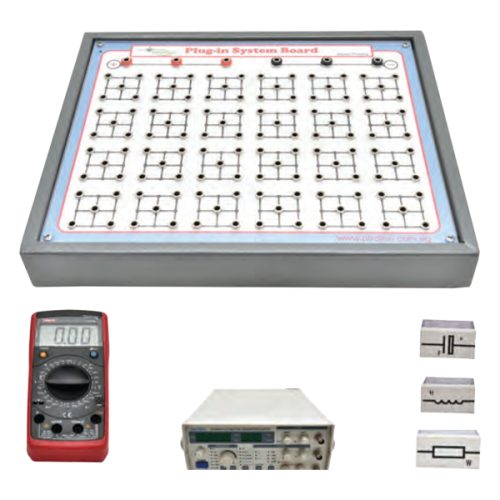
Overview
An RLC circuit consists of a resistor (R), an inductor (L), and a capacitor (C), connected in series or parallel. The circuit’s impedance depends on the frequency and the values of R, L, and C, and it is calculated as:

-
Series RLC Circuit:
In a series RLC circuit, the components are connected end-to-end. The current is the same throughout, but the voltage divides across the components. At resonance, the inductive and capacitive reactance cancel each other, and the circuit behaves like a purely resistive circuit.
-
Parallel RLC Circuit:
In a parallel RLC circuit, the components are connected in parallel branches. The voltage is the same across each component, and current divides among them. At resonance, the impedance is minimized, and current is maximized.
Significance:
-
RLC circuits are crucial in AC circuits, signal processing, and frequency filtering.
-
Series RLC circuits are used in radio tuning and frequency selection.
-
Parallel RLC circuits are used for controlling current flow at specific frequencies.